

 Post by
Why Responsive Web Design Matters for Business Growth in 2026
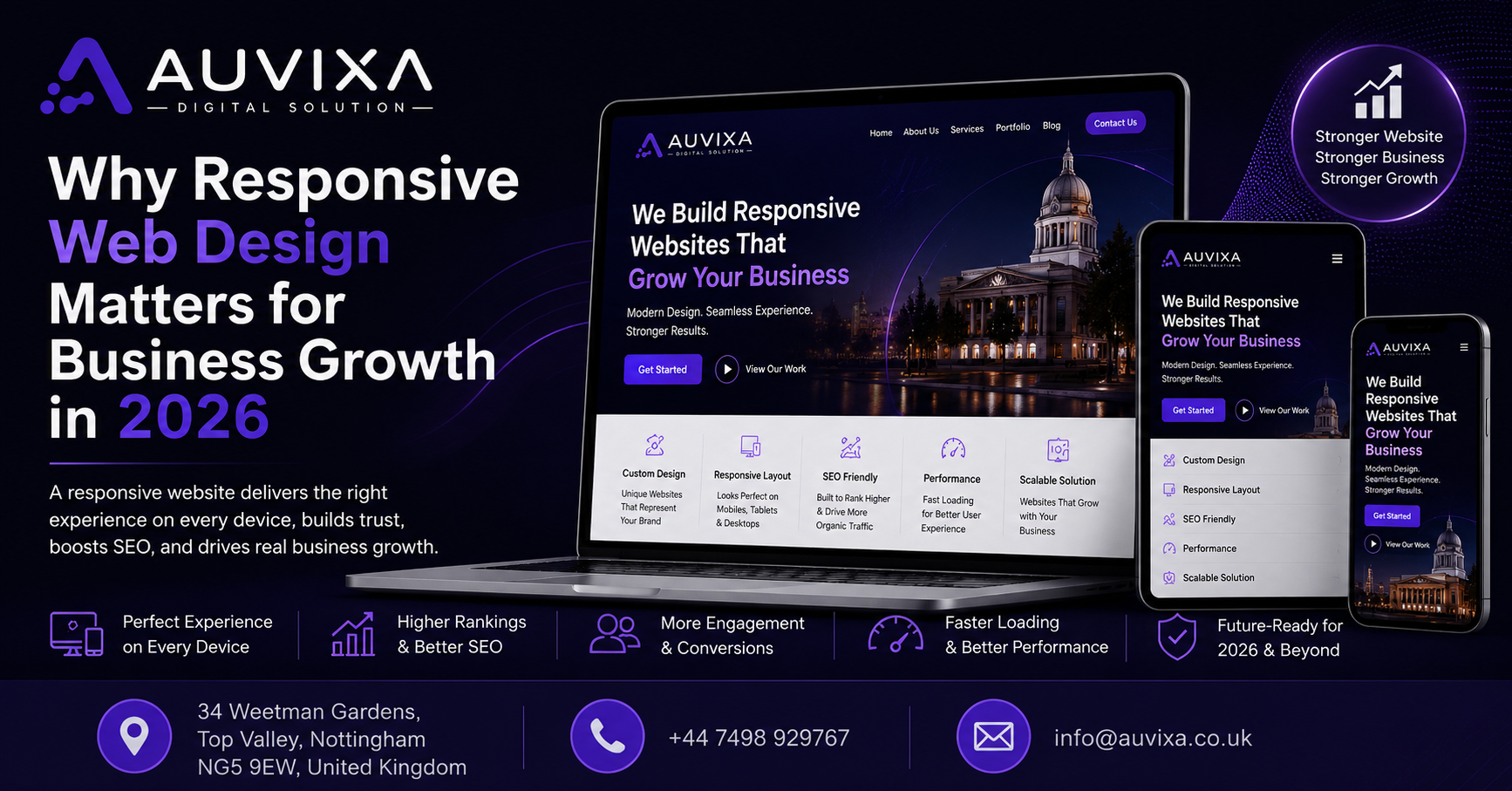
The digital landscape continues to evolve at an incredible pace, and businesses that fail to adapt risk losing customers to more agile competitors. One of the most important foundations of a successful online presence in 2026 is responsive web design. A responsive website automatically adjusts its layout, images, and content to provide an optimal viewing experience across smartphones, tablets, laptops, desktops, and even foldable devices.
Today, consumers expect fast, visually appealing, and easy-to-use websites regardless of the device they use. Google’s ranking systems increasingly reward websites that provide excellent user experiences, making responsive design not just a design preference but an essential SEO strategy.
Whether you’re running an eCommerce store, a SaaS platform, a local business, or a corporate website, responsive web design directly impacts traffic, customer engagement, lead generation, and revenue growth. This guide explores why responsive web design has become one of the smartest investments for businesses aiming to grow in 2026.
Why Responsive Web Design Matters for Business Growth in 2026
Understanding Responsive Web Design
Responsive web design is an approach that enables websites to automatically adapt to different screen sizes and resolutions. Instead of building separate desktop and mobile websites, businesses maintain one flexible website that delivers a seamless experience across all devices.
Modern responsive websites use flexible grids, CSS media queries, scalable images, and adaptive typography. This ensures that users never need to zoom in, scroll horizontally, or struggle with tiny buttons.
What Is Responsive Web Design?
Responsive web design allows a website to intelligently rearrange its content depending on the user’s screen size. Navigation menus become mobile-friendly, images resize proportionally, and text remains readable without compromising usability.
Rather than serving different versions of the same website, responsive design creates a unified experience. This consistency reduces maintenance costs while ensuring branding remains identical across devices.
For businesses, this translates into:
- Better customer satisfaction
- Lower bounce rates
- Higher engagement
- Improved search engine visibility
How Responsive Design Has Evolved
Responsive design has come a long way since smartphones first dominated internet traffic. In 2026, websites must support:
- Foldable devices
- Ultra-wide monitors
- High-resolution displays
- Voice-enabled browsing
- AI-assisted interfaces
- Wearable technology integrations
The focus has shifted beyond simply fitting content onto smaller screens. Modern responsive websites prioritize speed, accessibility, personalization, and interactive experiences that keep users engaged.

Why Responsive Web Design Matters for Business Growth in 2026
Why Businesses Need Responsive Websites in 2026
Consumer behavior has changed dramatically over the last decade. People now research products, compare prices, read reviews, and complete purchases using multiple devices throughout the day.
A customer might discover a business on a smartphone during breakfast, continue browsing on a tablet during lunch, and complete the purchase on a desktop in the evening. Responsive websites create a seamless journey across every touchpoint.
The Rise of Mobile-First Users
According to industry reports, mobile devices now generate well over half of global web traffic. In many industries, that number exceeds 70%.
Google’s mobile-first indexing means the mobile version of your website serves as the primary version used for ranking. Businesses with poor mobile experiences often experience:
- Lower search rankings
- Reduced traffic
- Higher bounce rates
- Fewer conversions
Responsive design ensures every visitor enjoys a smooth browsing experience regardless of their device.
Changing Customer Expectations
Today’s users expect websites to load almost instantly. Studies consistently show that visitors abandon websites that take more than a few seconds to load.
Consumers also expect:
- Simple navigation
- Clear call-to-action buttons
- Easy checkout processes
- Readable content
- Fast search functionality
Meeting these expectations builds trust and encourages repeat visits.
SEO Benefits of Responsive Web Design
Responsive web design plays a critical role in modern search engine optimization.
Google officially recommends responsive design because it simplifies crawling, indexing, and ranking websites.
Better Google Rankings
Having a single responsive website eliminates duplicate content issues that often occur with separate mobile websites.
Search engines can:
- Crawl pages more efficiently
- Consolidate ranking signals
- Improve indexing accuracy
- Strengthen domain authority
This often contributes to stronger organic visibility.
Improved Core Web Vitals
Core Web Vitals remain an important ranking factor in 2026.
Responsive websites typically perform better in metrics such as:
| Metric | Why It Matters |
|---|---|
| Largest Contentful Paint (LCP) | Faster loading experience |
| Interaction to Next Paint (INP) | Better responsiveness |
| Cumulative Layout Shift (CLS) | Stable visual experience |
Optimizing these metrics improves both rankings and user satisfaction.
Enhanced User Experience Signals
Google evaluates user engagement through behavioral signals including:
- Time on site
- Bounce rate
- Page views
- Return visits
Responsive websites naturally encourage visitors to stay longer because navigation feels effortless across all devices.
Business Growth Advantages
Responsive design directly influences revenue growth.
Companies investing in user-friendly websites often experience measurable improvements across marketing, sales, and customer retention.
Higher Conversion Rates
Visitors are far more likely to complete purchases, submit contact forms, or request quotes when websites function smoothly.
Responsive websites eliminate common friction points such as:
- Broken layouts
- Difficult navigation
- Tiny buttons
- Slow checkout processes
Each improvement increases the likelihood of conversion.
Increased Customer Trust
Professional design builds credibility.
When visitors encounter a clean, modern, responsive website, they naturally perceive the business as more reliable and established.
Trust becomes especially important in industries like:
- Healthcare
- Finance
- Legal services
- SaaS
- eCommerce
A polished website often serves as the first impression customers have of a business.
Stronger Brand Reputation
Consistent branding across devices reinforces recognition and professionalism.
Customers appreciate businesses that invest in quality digital experiences. Positive interactions often translate into better online reviews, referrals, and repeat purchases.
Responsive Design Best Practices
Successful responsive websites combine technical optimization with excellent user experience.
Fast Loading Speed
Website speed affects both SEO and customer satisfaction.
Best practices include:
- Compressing images
- Using modern image formats
- Minimizing JavaScript
- Leveraging browser caching
- Using Content Delivery Networks (CDNs)
Fast websites consistently outperform slower competitors.
Flexible Images and Layouts
Images should automatically resize without losing quality.
Fluid grids allow content to adapt naturally while maintaining visual balance across every screen size.
This flexibility ensures users enjoy the same quality experience regardless of their device.
Accessibility and Inclusive Design
Accessibility has become an essential business requirement rather than an optional feature.
Responsive websites should include:
- Proper heading structure
- Keyboard navigation
- High color contrast
- Screen reader compatibility
- Alternative image text
Inclusive design expands your audience while improving usability for everyone.
AI-Powered User Experiences
Artificial intelligence is becoming increasingly integrated into responsive websites.
Businesses are now using AI to deliver:
- Personalized recommendations
- Intelligent chatbots
- Predictive search
- Dynamic content
- Smart product suggestions
These features increase engagement while improving customer satisfaction.
Common Mistakes to Avoid
Many businesses mistakenly assume their websites are mobile-friendly simply because they display on smartphones.
True responsiveness requires thoughtful optimization.
Ignoring Mobile Performance
Heavy animations, oversized images, and unnecessary scripts significantly slow mobile performance.
Regular testing with tools like Google PageSpeed Insights and Lighthouse helps identify performance bottlenecks.
Poor Navigation and UX
Complicated menus frustrate users.
Responsive navigation should prioritize:
- Simple menus
- Large touch targets
- Clear CTAs
- Logical page hierarchy
- Minimal distractions
Small improvements in navigation often produce substantial gains in conversion rates.
Conclusion
Responsive web design has evolved into one of the most important drivers of digital business success in 2026. It strengthens SEO performance, enhances user experience, builds customer trust, and increases conversion rates while reducing long-term maintenance costs. As Google’s algorithms continue prioritizing user-centric experiences and consumers access websites from an expanding range of devices, businesses that invest in responsive design gain a significant competitive advantage.
Rather than viewing responsive design as a one-time development task, organizations should treat it as an ongoing strategy that adapts to new technologies, user behaviors, and search engine requirements. Companies that prioritize fast loading speeds, accessibility, mobile optimization, and AI-powered personalization will be better positioned to attract visitors, retain customers, and achieve sustainable business growth in the years ahead.
FAQs
1. What is responsive web design?
Responsive web design is a development approach that allows a website to automatically adapt its layout and content to different screen sizes and devices, providing a consistent user experience.
2. Does responsive web design improve SEO?
Yes. Responsive websites align with Google’s recommendations, support mobile-first indexing, improve Core Web Vitals, and enhance user experience—all of which contribute to stronger search rankings.
3. Why is responsive design important for business growth?
A responsive website increases customer satisfaction, improves conversion rates, reduces bounce rates, strengthens brand credibility, and helps businesses reach users across all devices.
4. How does responsive design affect website speed?
When properly optimized, responsive websites load faster through techniques such as image compression, efficient coding, browser caching, and content delivery networks, improving both user experience and SEO performance.
5. Is responsive web design still relevant in 2026?
Absolutely. With mobile usage continuing to grow, Google emphasizing user experience, and new device formats such as foldable screens becoming more common, responsive web design remains a critical investment for businesses seeking long-term online success.
6. How much does it cost to build a responsive website in 2026?
The cost depends on the website’s size, complexity, and features. A basic business website may cost a few thousand dollars, while custom eCommerce or enterprise websites can require a significantly larger investment. Although the upfront cost varies, responsive design often reduces long-term maintenance expenses by eliminating the need for separate desktop and mobile sites.
7. Can an existing website be made responsive?
Yes. In many cases, developers can redesign an existing website to use responsive layouts without rebuilding it from scratch. If the site uses outdated technology or has major performance issues, a complete redesign may be the more efficient long-term solution.
8. What is the difference between responsive and mobile-friendly design?
A mobile-friendly website is designed to work on mobile devices, but it may not adapt seamlessly to different screen sizes. A responsive website automatically adjusts its layout, images, and content to provide an optimal experience on smartphones, tablets, laptops, and desktop computers.
9. How does responsive web design improve customer retention?
A responsive website offers a smooth and consistent browsing experience across all devices, making it easier for visitors to find information, complete purchases, or contact your business. Positive user experiences encourage repeat visits, increase customer satisfaction, and strengthen brand loyalty.
10. Does responsive web design help with local SEO?
Yes. Responsive websites typically provide better mobile experiences, which are important for local searches since many users look for nearby businesses on their smartphones. Combined with optimized Google Business Profiles, local keywords, and fast-loading pages, responsive design can improve visibility in local search results.
11. Is responsive web design important for eCommerce businesses?
Absolutely. Online shoppers frequently switch between devices before making a purchase. A responsive eCommerce website ensures product pages, shopping carts, and checkout processes function smoothly across all screen sizes, helping reduce cart abandonment and increase sales.
12. What tools can be used to test responsive web design?
Popular tools include:
- Google PageSpeed Insights
- Google Lighthouse
- Chrome DevTools Device Mode
- BrowserStack
- GTmetrix
- WebPageTest
These tools help evaluate responsiveness, loading speed, accessibility, and overall website performance.
13. How often should a responsive website be updated?
A responsive website should be reviewed regularly to ensure compatibility with new browsers, operating systems, and devices. Performance audits, security updates, and UX improvements should ideally be conducted every few months or whenever significant changes are made to the website.
14. Does responsive design improve website accessibility?
Yes. Responsive design supports accessibility by making content easier to read and navigate on different devices. When combined with accessible practices such as keyboard navigation, descriptive alt text, proper heading structure, and sufficient color contrast, it creates a better experience for all users, including those with disabilities.
15. What are the biggest responsive web design trends in 2026?
Some of the leading trends include AI-powered personalization, voice search optimization, support for foldable devices, dark mode compatibility, progressive web apps (PWAs), enhanced Core Web Vitals optimization, and accessibility-first design. Businesses that adopt these trends are better positioned to deliver modern user experiences and remain competitive in an evolving digital landscape.
