

 Post by
Bespoke Software Solutions for UK Businesses: A Complete Guide to Driving Digital Transformation
The UK business landscape has undergone a remarkable digital transformation over the past decade. Organizations across industries—including healthcare, finance, retail, manufacturing, logistics, education, and professional services—are embracing technology to improve efficiency, enhance customer experiences, and remain competitive in an increasingly digital economy. While many companies initially rely on off-the-shelf software, they often discover that generic applications cannot fully support their unique workflows, operational processes, or long-term business objectives. This growing demand for tailored technology has led to the rapid adoption of bespoke software solutions for UK businesses.
Bespoke software, also known as custom software, is designed and developed specifically for the requirements of a single organization. Unlike pre-packaged software that serves a broad audience, bespoke applications are built around a company’s existing processes, allowing businesses to automate tasks, eliminate inefficiencies, improve collaboration, and gain complete control over their digital operations. Whether it’s a custom CRM system, inventory management platform, customer portal, enterprise resource planning (ERP) solution, or mobile application, bespoke software provides businesses with the flexibility to create exactly what they need instead of adapting their operations to fit standard software limitations.
According to industry research from Statista and Gartner, global spending on enterprise software continues to rise as organizations prioritize automation, cloud computing, artificial intelligence, and digital transformation initiatives. UK businesses are increasingly investing in custom software development because it offers scalability, stronger security, improved integration with existing systems, and long-term cost efficiency. Rather than paying recurring licensing fees for multiple disconnected applications, companies can build a centralized solution tailored to their operational goals.
Another significant advantage of bespoke software is its ability to provide a competitive edge. Businesses operating in highly competitive sectors need technology that enables faster decision-making, streamlined customer service, and optimized internal processes. A well-designed bespoke solution not only improves productivity but also creates opportunities for innovation by introducing unique features that competitors may not have.
This comprehensive guide explores everything UK businesses need to know about bespoke software solutions, including their benefits, key features, industry applications, implementation considerations, and how to choose the right software development partner for long-term success.
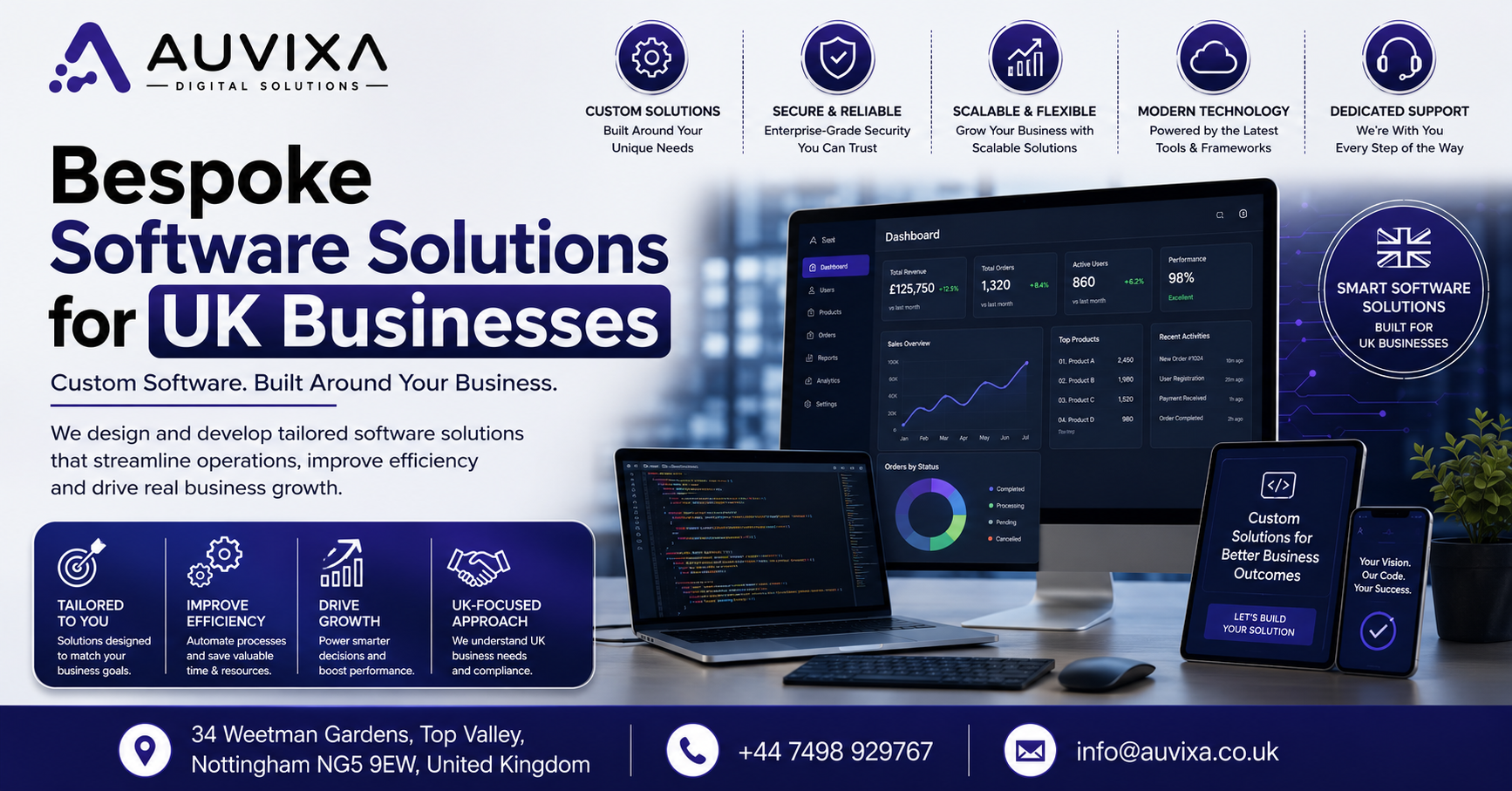
Bespoke Software Solutions for UK Businesses
What Are Bespoke Software Solutions?
Bespoke software solutions are custom-built applications designed to meet the unique needs of a specific business rather than serving a broad market. Unlike off-the-shelf software, which is created for mass use with standardized features, bespoke software is developed from the ground up to align with an organization’s workflows, objectives, and operational requirements. Every feature, interface, integration, and automation is tailored to solve real business challenges, making bespoke software a strategic investment for companies seeking efficiency, scalability, and long-term growth.
As UK businesses continue to embrace digital transformation, the demand for customized software has grown significantly. Companies often discover that generic software forces employees to adjust their processes to fit the application, resulting in unnecessary workarounds and reduced productivity. Bespoke software takes the opposite approach—it adapts to the business rather than requiring the business to adapt to the software. This enables organizations to streamline operations, automate repetitive tasks, and eliminate inefficiencies that may be slowing growth.
One of the biggest advantages of bespoke software is flexibility. Businesses evolve over time, introducing new products, expanding into different markets, or complying with updated regulations. Custom software can be modified and enhanced whenever new requirements arise, ensuring it continues to support business objectives without requiring a complete system replacement. This makes bespoke software particularly valuable for growing businesses that expect their operational needs to change over the coming years.
Modern bespoke software also integrates seamlessly with existing business systems such as CRM platforms, ERP software, accounting systems, payment gateways, HR applications, cloud storage, and third-party APIs. Instead of managing multiple disconnected applications, businesses gain a centralized ecosystem where information flows automatically between departments. This improves collaboration, reduces manual data entry, minimizes errors, and provides decision-makers with accurate, real-time insights into business performance.
Beyond operational improvements, bespoke software offers organizations greater control over security, user permissions, and compliance. Since the software is built specifically for one organization, businesses can implement customized security measures, data encryption, audit trails, and access controls that align with their industry standards and regulatory obligations.
Definition of Bespoke Software
Bespoke software is a custom-developed application created exclusively for one business or organization to address its specific operational needs. Unlike commercially available software packages that offer the same functionality to thousands of users, bespoke software is designed around unique business requirements, ensuring every feature contributes directly to improving productivity and business performance.
Examples of bespoke software include:
- Custom Customer Relationship Management (CRM) systems
- Enterprise Resource Planning (ERP) solutions
- Inventory management platforms
- Warehouse management systems
- Patient management software
- Online booking systems
- E-commerce platforms
- Employee portals
- Mobile business applications
- Customer self-service portals
These solutions are developed using modern technologies and can be customized further as business requirements evolve.
Bespoke Software vs. Off-the-Shelf Software
Choosing between bespoke software and off-the-shelf software is one of the most important technology decisions a business can make. While both options have advantages, they serve different purposes depending on the organization’s size, complexity, and long-term goals.
Off-the-shelf software is designed to meet the general needs of a wide audience. It is typically faster to deploy and less expensive upfront because development costs are shared across many customers. However, businesses often pay for features they never use while lacking functionality that is essential to their operations. Customization options are usually limited, and organizations must adapt their workflows to fit the software.
Bespoke software, by contrast, is developed specifically for one business. Every feature is purpose-built, allowing organizations to automate unique processes, improve efficiency, and scale without being restricted by generic software limitations. Although custom software requires a higher initial investment, it often delivers greater long-term value by reducing licensing costs, improving productivity, and eliminating the need for multiple disconnected applications.
| Feature | Bespoke Software | Off-the-Shelf Software |
|---|---|---|
| Customization | Fully customizable | Limited customization |
| Scalability | Highly scalable | May require upgrades or replacement |
| Integration | Built for existing systems | Limited integration options |
| Ownership | Business owns the solution | Vendor retains ownership |
| Initial Cost | Higher | Lower |
| Long-Term Value | Excellent | Moderate |
| Competitive Advantage | High | Low |
| Security | Tailored security controls | Standard security features |
For many UK businesses experiencing growth or operating in specialized industries, bespoke software provides the flexibility and competitive advantage that standardized software simply cannot deliver.
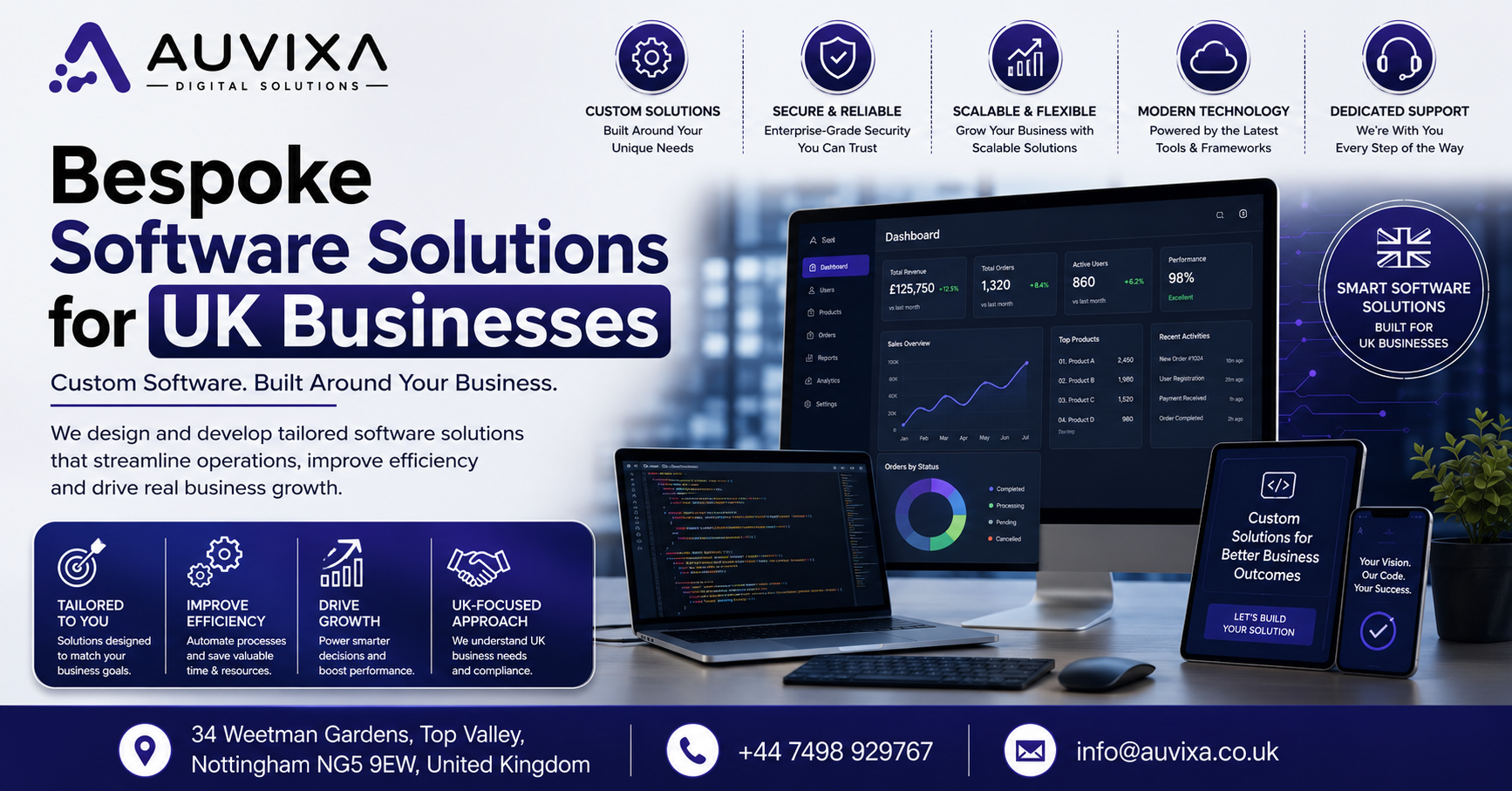
Bespoke Software Solutions for UK Businesses
Why UK Businesses Are Investing in Bespoke Software
Across the United Kingdom, organizations are increasingly investing in bespoke software to support digital transformation, improve operational efficiency, and create better customer experiences. From startups in London to manufacturing firms in Birmingham and healthcare providers across the country, businesses recognize that technology is no longer just a support function—it has become a key driver of growth and innovation.
One major factor behind this trend is increasing competition. Businesses must respond quickly to changing customer expectations, evolving regulations, and market demands. Generic software often lacks the flexibility needed to support these rapid changes, whereas bespoke software can be updated and expanded whenever new requirements emerge.
Automation is another significant reason for investing in custom software. Manual processes consume valuable employee time and increase the risk of errors. Bespoke software automates repetitive tasks such as invoice generation, customer onboarding, reporting, inventory updates, and workflow approvals, allowing employees to focus on higher-value activities.
Remote and hybrid working have also accelerated the adoption of custom digital solutions. Businesses need secure cloud-based platforms that enable employees to collaborate efficiently regardless of location. Bespoke software provides centralized access to business data while maintaining strong security standards.
In addition, UK businesses must comply with regulations such as the UK GDPR, data protection laws, financial reporting standards, and industry-specific compliance requirements. Bespoke software allows organizations to build compliance directly into their systems, reducing legal risks while improving operational transparency.
Companies that invest in bespoke software are not simply purchasing technology—they are building digital infrastructure capable of supporting innovation, operational excellence, and sustainable business growth.
Digital Transformation Across Industries
Digital transformation is affecting virtually every industry in the UK. Businesses are replacing paper-based processes, spreadsheets, and disconnected legacy systems with integrated digital platforms that improve productivity and customer satisfaction.
Examples include:
- Healthcare providers implementing patient management systems
- Retailers developing custom e-commerce platforms
- Manufacturers automating production workflows
- Financial firms improving compliance and reporting
- Logistics companies optimizing fleet management
- Educational institutions creating online learning platforms
Bespoke software enables each organization to digitize processes according to its specific operational requirements rather than relying on generic solutions.
Meeting Industry-Specific Requirements
Different industries have unique operational challenges, regulations, and customer expectations. A one-size-fits-all software solution rarely addresses every requirement effectively.
For example:
- Healthcare organizations require secure patient records and compliance with healthcare regulations.
- Financial services need fraud prevention, secure transactions, and regulatory reporting.
- Manufacturers require production planning, inventory management, and quality control.
- Retail businesses benefit from integrated e-commerce, CRM, and inventory management.
- Logistics companies need real-time shipment tracking, route optimization, and warehouse management.
Bespoke software allows businesses to implement features specifically designed for their industry while maintaining flexibility for future growth.
Key Features of Bespoke Software Solutions
One of the primary reasons businesses choose bespoke software over off-the-shelf applications is the ability to build features that align perfectly with their operational requirements. Every organization has unique workflows, customer interactions, reporting needs, and compliance obligations that generic software may not fully support. Bespoke software eliminates unnecessary functionality while incorporating the exact tools needed to improve efficiency, collaboration, and decision-making.
Unlike standardized software, which often requires businesses to adapt their processes, bespoke software is designed around existing workflows. This results in improved productivity because employees can perform their tasks using a system that reflects how the business actually operates. From automating repetitive administrative work to providing real-time dashboards and integrating multiple business systems, bespoke software simplifies daily operations while reducing manual effort.
Modern bespoke solutions are also built using scalable technologies, enabling businesses to expand functionality as they grow. Whether opening new offices, launching additional products, serving more customers, or entering international markets, custom software can evolve without requiring a complete replacement. This flexibility protects the initial investment while ensuring the technology continues supporting future business objectives.
Another important feature is seamless integration. Many businesses rely on multiple software applications for accounting, customer management, inventory, payroll, marketing, and communications. Bespoke software connects these systems through APIs and automated workflows, creating a centralized platform where information is synchronized across departments. This eliminates duplicate data entry, improves reporting accuracy, and enhances collaboration.
Security and compliance are equally important. Since bespoke software is developed specifically for one organization, businesses have complete control over authentication methods, user permissions, encryption standards, and data storage policies. This makes it easier to comply with regulations such as UK GDPR, industry-specific standards, and internal security policies.
Below are some of the most valuable features businesses should expect from a modern bespoke software solution.
Custom Functionality
The defining characteristic of bespoke software is its ability to deliver functionality designed exclusively for a specific organization. Rather than paying for unnecessary features included in commercial software, businesses receive tools that directly support their day-to-day operations.
For example, a logistics company may require automated route optimization and shipment tracking, while a law firm may need document management and case tracking. A healthcare provider might prioritize secure patient records, appointment scheduling, and electronic prescriptions. Because every feature is built around actual business processes, employees work more efficiently and experience fewer operational frustrations.
Custom functionality also allows organizations to automate repetitive tasks such as invoice generation, approval workflows, inventory updates, report creation, customer notifications, and data synchronization. Automation reduces manual errors, saves valuable time, and enables staff to focus on strategic activities instead of administrative work.
Additional advantages include:
- Personalized dashboards
- Industry-specific workflows
- Automated reporting
- Role-based user interfaces
- Custom approval processes
- Tailored customer portals
- Department-specific modules
By developing software around business requirements instead of generic templates, companies gain a solution that supports both current operations and future innovation.
Bespoke Software Solutions for UK Businesses
Scalability and Flexibility
Business growth often brings new operational challenges. Companies may hire additional employees, open new branches, introduce new products, expand internationally, or acquire other organizations. Software that cannot scale quickly becomes a limitation rather than an asset.
Bespoke software is designed with scalability in mind. Developers can add new features, integrate emerging technologies, support additional users, and expand system capabilities without disrupting existing operations. This ensures businesses continue benefiting from their software investment even as organizational requirements evolve.
Flexibility also extends to workflow customization. As internal processes change, bespoke software can be modified to reflect updated procedures, new compliance regulations, or changing customer expectations. Instead of purchasing an entirely new platform every few years, organizations simply enhance their existing solution.
Scalable software supports:
- Multi-office operations
- Multi-user environments
- International expansion
- Multi-language capabilities
- Multi-currency transactions
- Increased customer volumes
- Additional product lines
- Future technology integrations
This adaptability makes bespoke software an excellent long-term investment for businesses planning sustainable growth.
Advanced Security and Compliance
Cybersecurity has become one of the biggest concerns for businesses of every size. Data breaches, ransomware attacks, phishing attempts, and unauthorized access can result in financial losses, reputational damage, and regulatory penalties. Bespoke software allows organizations to implement security measures specifically designed for their operational requirements rather than relying solely on standard vendor configurations.
Developers can build advanced authentication systems, role-based permissions, encrypted databases, secure APIs, and detailed audit logs into the application from the beginning. These controls help protect sensitive business information while ensuring employees only access data relevant to their responsibilities.
Compliance is equally important, particularly for businesses operating in regulated industries. Bespoke software can be developed to meet requirements related to UK GDPR, ISO standards, healthcare regulations, financial reporting obligations, and sector-specific compliance frameworks.
Common security features include:
- Multi-factor authentication (MFA)
- Data encryption
- Role-based access control
- Audit trails
- Secure cloud hosting
- Automated backups
- Activity monitoring
- Compliance reporting
These capabilities strengthen business resilience while protecting valuable customer and organizational data.
Third-Party System Integration
Most businesses use multiple digital platforms to manage different aspects of their operations. Without integration, employees often spend significant time transferring information between systems manually, increasing the risk of errors and inconsistent data.
Bespoke software eliminates these inefficiencies by connecting with existing business applications through APIs and automated workflows. Information entered once can automatically update across accounting software, CRM platforms, payment gateways, inventory systems, HR applications, email marketing tools, and business intelligence platforms.
For example, when a customer places an online order, the bespoke application can automatically update inventory levels, generate an invoice, notify the warehouse, schedule delivery, and record the financial transaction without any manual intervention.
Popular integrations include:
- Microsoft 365
- Salesforce
- HubSpot CRM
- Xero
- QuickBooks
- Stripe
- PayPal
- Shopify
- WooCommerce
- Microsoft Power BI
Integrated systems improve operational efficiency while providing a complete, real-time view of business performance.
Cloud-Based Accessibility
Cloud technology has transformed how businesses access and manage software. Modern bespoke applications are increasingly developed as cloud-based solutions, allowing employees to work securely from virtually any location with an internet connection.
Cloud-based bespoke software eliminates the need for expensive on-premise servers while reducing maintenance costs and simplifying software updates. Employees working remotely or across multiple office locations can collaborate using the same real-time information, improving communication and productivity.
Cloud infrastructure also provides automatic backups, disaster recovery capabilities, high availability, and enhanced scalability. Businesses can increase storage capacity, add new users, or deploy additional features without significant hardware investments.
Benefits of cloud-based bespoke software include:
- Remote access
- Automatic updates
- Lower infrastructure costs
- Enhanced collaboration
- Improved scalability
- Business continuity
- Secure data storage
- Faster deployment
As hybrid and remote working continue to grow across the UK, cloud-based bespoke software provides organizations with the flexibility needed to support modern business operations.
Benefits of Bespoke Software for UK Businesses
Investing in bespoke software solutions for UK businesses is more than a technology upgrade—it is a strategic decision that can transform how an organization operates, serves customers, and competes in its industry. While off-the-shelf software offers convenience, it often includes unnecessary features, limited customization, and recurring licensing costs that can become expensive over time. Bespoke software, on the other hand, is designed specifically to support a company’s goals, enabling businesses to work more efficiently while adapting quickly to changing market conditions.
One of the biggest advantages of bespoke software is improved operational efficiency. By automating repetitive tasks and integrating multiple business functions into a single platform, organizations can reduce manual workloads, minimize errors, and accelerate decision-making. Employees spend less time switching between different systems and more time focusing on activities that drive business growth.
Customer experience is another area where bespoke software delivers significant value. Businesses can create personalized customer portals, streamline communication, provide real-time updates, and offer services tailored to their audience’s needs. This level of customization strengthens customer relationships, increases satisfaction, and improves retention rates.
Bespoke software also provides long-term flexibility. As businesses expand into new markets, launch additional products, or introduce new services, the software can evolve alongside the organization. Rather than replacing an outdated system every few years, companies simply add new modules or features, protecting their initial investment while reducing future development costs.
For UK businesses operating in competitive sectors, bespoke software creates a genuine competitive advantage. Unique workflows, specialized reporting, advanced automation, and seamless integrations enable organizations to operate more efficiently than competitors relying on generic software. This competitive edge often translates into higher productivity, improved profitability, and stronger customer loyalty.
Increased Productivity and Efficiency
One of the primary reasons businesses invest in bespoke software is to improve productivity. Manual processes, duplicate data entry, disconnected systems, and inefficient workflows consume valuable employee time and increase the likelihood of mistakes. Bespoke software eliminates these challenges by automating routine tasks and creating a centralized environment where information is shared across departments in real time.
For example, a sales order entered into the system can automatically update inventory levels, notify the warehouse, generate an invoice, and trigger delivery scheduling without requiring multiple employees to perform separate actions. This streamlined workflow reduces processing times while improving accuracy.
Employees also benefit from intuitive user interfaces designed specifically for their daily responsibilities. Instead of navigating through unnecessary menus and features found in generic software, they have quick access to the tools and information they need. This shortens training time, improves user adoption, and increases overall efficiency.
Other productivity benefits include:
- Automated workflows
- Faster data processing
- Reduced paperwork
- Real-time reporting
- Improved collaboration
- Better resource allocation
- Centralized business information
- Fewer manual errors
As a result, businesses can complete more work in less time while maintaining high levels of quality and customer service.
Long-Term Cost Savings
Although bespoke software typically requires a larger initial investment than off-the-shelf applications, it often provides substantial cost savings over the long term. Many businesses underestimate the hidden expenses associated with commercial software, including recurring subscription fees, additional licensing costs, expensive upgrades, and the need to purchase multiple applications to cover different business functions.
Bespoke software eliminates many of these ongoing expenses by providing a single integrated solution designed specifically for the organization’s requirements. Since businesses own the software, they have greater control over future development, maintenance, and enhancements without being dependent on vendor pricing or product roadmaps.
Custom software also reduces operational costs by improving efficiency. Automated processes minimize labor-intensive tasks, reduce administrative overhead, and decrease the likelihood of costly errors. Better reporting and analytics help management identify inefficiencies, optimize resource allocation, and make informed financial decisions.
Additional long-term financial benefits include:
- Lower software licensing costs
- Reduced operational expenses
- Increased employee productivity
- Fewer system integration costs
- Lower maintenance requirements
- Reduced training expenses
- Better return on technology investments
- Improved scalability without replacing systems
When evaluated over several years, bespoke software often delivers a significantly higher return on investment (ROI) than relying on multiple disconnected software applications.
Bespoke Software Solutions for UK Businesses
Industries That Benefit from Bespoke Software
Virtually every industry can benefit from bespoke software, but certain sectors experience particularly significant advantages due to their complex workflows, regulatory requirements, and need for specialized functionality. Custom software allows organizations to solve industry-specific challenges while improving operational efficiency, customer satisfaction, and business performance.
In the healthcare sector, bespoke software supports patient management, appointment scheduling, electronic medical records (EMR), prescription management, and secure communication between healthcare professionals. These systems help providers deliver better patient care while maintaining compliance with healthcare regulations and data protection laws.
The financial services industry relies on bespoke software for secure payment processing, fraud detection, customer onboarding, regulatory reporting, and risk management. Financial institutions require highly secure systems capable of handling sensitive customer information while complying with strict regulatory standards.
In retail and e-commerce, bespoke software integrates inventory management, online stores, customer relationship management (CRM), order processing, and payment gateways into a single platform. This improves the shopping experience while enabling businesses to manage inventory more effectively and respond quickly to customer demand.
Manufacturing companies use bespoke software to optimize production planning, warehouse management, procurement, supply chain operations, quality control, and equipment maintenance. Automated workflows improve efficiency while reducing production costs and minimizing downtime.
The logistics and transportation industry benefits from custom fleet management systems, shipment tracking, warehouse automation, delivery scheduling, and route optimization. These solutions improve delivery accuracy, reduce transportation costs, and provide customers with real-time shipment updates.
Other industries benefiting from bespoke software include:
- Education
- Construction
- Legal services
- Hospitality
- Real estate
- Professional services
- Government organizations
- Non-profit organizations
Regardless of industry, bespoke software enables businesses to digitize operations, improve collaboration, and respond more effectively to changing market demands.
How to Choose the Right Bespoke Software Development Company
Choosing the right software development partner is just as important as deciding to invest in bespoke software. A skilled development company doesn’t simply write code—it works closely with your business to understand your goals, identify operational challenges, and build a solution that delivers measurable value. The wrong partner can lead to missed deadlines, budget overruns, security vulnerabilities, and software that fails to meet business requirements. Taking the time to evaluate potential vendors carefully can significantly improve the success of your project.
Start by assessing the company’s experience and portfolio. Look for a development team that has successfully delivered bespoke software projects for businesses similar to yours or within your industry. Case studies, client testimonials, and online reviews provide valuable insights into their technical expertise, communication style, and ability to meet deadlines. A reputable software development company should also be transparent about its development methodology, project timelines, pricing structure, and post-launch support.
Communication plays a critical role throughout the software development lifecycle. Choose a company that provides regular progress updates, gathers feedback during each development stage, and involves stakeholders in important decisions. Agile development methodologies are particularly beneficial because they allow businesses to review working software throughout the project rather than waiting until completion.
Technical expertise is another essential consideration. Ensure the development company has experience with modern programming languages, cloud technologies, API integrations, cybersecurity best practices, artificial intelligence, and mobile application development if required. They should also prioritize software testing, quality assurance, and ongoing maintenance to ensure long-term reliability.
Finally, evaluate the company’s commitment to ongoing support. Bespoke software is a long-term investment that will likely require updates, security patches, feature enhancements, and performance optimization as your business evolves. Choosing a development partner that offers comprehensive post-launch support ensures your software continues delivering value for years to come.
Questions to Ask Before Hiring
Before selecting a bespoke software development company, ask these important questions:
- Have you developed software for businesses in my industry?
- Can you provide case studies or client references?
- What development methodology do you follow (Agile, Scrum, Waterfall)?
- How do you estimate project timelines and costs?
- What security standards do you implement?
- Will I own the source code after project completion?
- What ongoing maintenance and support services do you offer?
- How do you manage software updates and bug fixes?
- Can the software integrate with my existing business systems?
- What is your approach to testing and quality assurance?
The answers to these questions will help you compare vendors and select a partner capable of delivering a reliable, scalable, and secure software solution.Common Mistakes to Avoid
Many businesses make avoidable mistakes when investing in bespoke software. One of the most common is focusing solely on the lowest development cost. While staying within budget is important, choosing the cheapest provider can lead to poor code quality, missed deadlines, limited scalability, and higher maintenance costs in the future.
Another mistake is failing to define clear project requirements. Without detailed specifications, developers may build features that don’t fully align with business needs. Creating a comprehensive project scope before development begins helps prevent misunderstandings and costly revisions later.
Businesses also underestimate the importance of user involvement. Employees who will use the software daily should participate in requirement gathering, testing, and feedback sessions. Their practical insights often lead to improvements that increase usability and productivity.
Ignoring future scalability is another costly error. A bespoke solution should be designed to accommodate business growth, new technologies, additional users, and changing operational requirements. Building with scalability in mind reduces redevelopment costs and extends the software’s lifespan.
Lastly, don’t overlook ongoing maintenance. Even the best software requires regular updates, performance improvements, and security patches. Planning for long-term support ensures the application remains secure, reliable, and compatible with evolving technologies.
Future of Bespoke Software Solutions in the UK
The future of bespoke software solutions for UK businesses is being shaped by rapid technological innovation and evolving customer expectations. As organizations continue their digital transformation journeys, custom software will become even more intelligent, connected, and data-driven. Businesses that invest in modern bespoke solutions today will be better positioned to adapt to future market changes and maintain a competitive advantage.
One of the biggest trends is the adoption of Artificial Intelligence (AI) and Machine Learning (ML). AI-powered bespoke applications can automate repetitive tasks, analyze customer behavior, predict future trends, and provide real-time recommendations that improve business performance. Customer service chatbots, intelligent reporting systems, predictive maintenance, and automated workflow management are becoming standard features in many custom software projects.
Cloud computing will continue to dominate software development across the UK. Cloud-native applications provide greater scalability, enhanced collaboration, lower infrastructure costs, and faster deployment compared to traditional on-premise systems. Businesses can securely access their software from any location while benefiting from automatic updates and improved disaster recovery capabilities.
Another emerging trend is the growing use of low-code and no-code platforms alongside bespoke development. While complex business applications still require experienced developers, these platforms can accelerate development by simplifying certain components and allowing businesses to implement new features more quickly.
Cybersecurity will remain a top priority. As cyber threats become increasingly sophisticated, bespoke software developers will continue integrating advanced security measures such as zero-trust architecture, biometric authentication, AI-driven threat detection, end-to-end encryption, and continuous security monitoring. Compliance with UK GDPR and other industry regulations will also remain essential for businesses handling sensitive customer data.
The Internet of Things (IoT) is creating new opportunities for bespoke software in industries such as manufacturing, logistics, healthcare, and construction. Connected devices generate valuable real-time data that custom software can analyze to improve efficiency, monitor equipment, optimize supply chains, and enhance customer experiences.
Sustainability is another growing focus. Many UK businesses are investing in software solutions that help monitor carbon emissions, reduce waste, improve energy efficiency, and support Environmental, Social, and Governance (ESG) reporting. Bespoke software enables organizations to measure sustainability performance while meeting corporate responsibility goals.
Looking ahead, bespoke software will continue evolving beyond operational management into a strategic business asset. Companies that embrace innovation, automation, cloud technologies, and AI-powered solutions will be better equipped to increase productivity, improve customer satisfaction, and achieve sustainable long-term growth.
Conclusion
Investing in bespoke software solutions for UK businesses is a strategic decision that enables organizations to improve efficiency, streamline operations, and gain a lasting competitive advantage. Unlike off-the-shelf software, bespoke applications are developed specifically to meet unique business requirements, allowing companies to automate workflows, integrate existing systems, strengthen security, and support future growth without unnecessary limitations.
Whether you’re a startup seeking a custom customer portal, a retailer building an integrated e-commerce platform, a healthcare provider improving patient management, or a manufacturer optimizing production processes, bespoke software provides the flexibility and scalability needed to succeed in today’s digital economy. By partnering with an experienced software development company, businesses can create tailored solutions that deliver measurable improvements in productivity, customer experience, and operational performance.
As technologies such as artificial intelligence, cloud computing, IoT, and advanced analytics continue to reshape the business landscape, bespoke software will remain a key driver of digital transformation across the UK. Organizations that invest in customized technology today will be better prepared to adapt to future challenges, seize new opportunities, and achieve sustainable business growth.
Frequently Asked Questions (FAQs)
1. What are bespoke software solutions?
Bespoke software solutions are custom-developed applications designed specifically for the unique needs of a business. Unlike off-the-shelf software, they are tailored to support specific workflows, business processes, and operational goals.
2. Why should UK businesses choose bespoke software over off-the-shelf software?
Bespoke software offers greater flexibility, scalability, enhanced security, seamless integrations, and long-term cost efficiency. It allows businesses to build solutions that fit their operations instead of adapting to the limitations of generic software.
3. How much does bespoke software development cost in the UK?
The cost depends on factors such as project complexity, required features, integrations, development time, and technology stack. Small projects may cost a few thousand dollars, while enterprise-level solutions can require significantly larger investments. Most development companies provide custom quotes after gathering project requirements.
4. How long does it take to develop bespoke software?
Development timelines vary depending on the project’s size and complexity. A simple application may take 2–4 months, while larger enterprise solutions can take 6–12 months or longer, including planning, development, testing, and deployment.
5. Is bespoke software suitable for small businesses?
Yes. Bespoke software can be an excellent investment for small businesses, particularly those with unique processes or growth plans. It helps improve efficiency, automate manual tasks, and scale operations without relying on multiple disconnected applications.
6. Can bespoke software integrate with existing business systems?
Absolutely. Custom software can integrate with CRM platforms, ERP systems, accounting software, payment gateways, cloud services, marketing tools, and other third-party applications using APIs and secure integrations.
7. Is bespoke software secure?
Yes. Because bespoke software is built specifically for one organization, developers can implement advanced security features such as encryption, multi-factor authentication, role-based access control, audit logs, and compliance with UK GDPR and industry regulations.
8. Which industries benefit the most from bespoke software?
Industries including healthcare, finance, retail, manufacturing, logistics, education, legal services, construction, hospitality, and real estate all benefit from bespoke software because it addresses their specific operational and compliance requirements.
9. Can bespoke software grow with my business?
Yes. One of the greatest advantages of bespoke software is scalability. New features, users, integrations, and modules can be added as your business expands, ensuring the software continues to meet your evolving requirements.
10. How do I choose the best bespoke software development company in the UK?
Look for a company with relevant industry experience, a strong portfolio, positive client reviews, transparent pricing, modern development practices, robust security expertise, and comprehensive post-launch support. Request demonstrations, review case studies, and ensure the company understands your business objectives before making a decision.
