
 Post by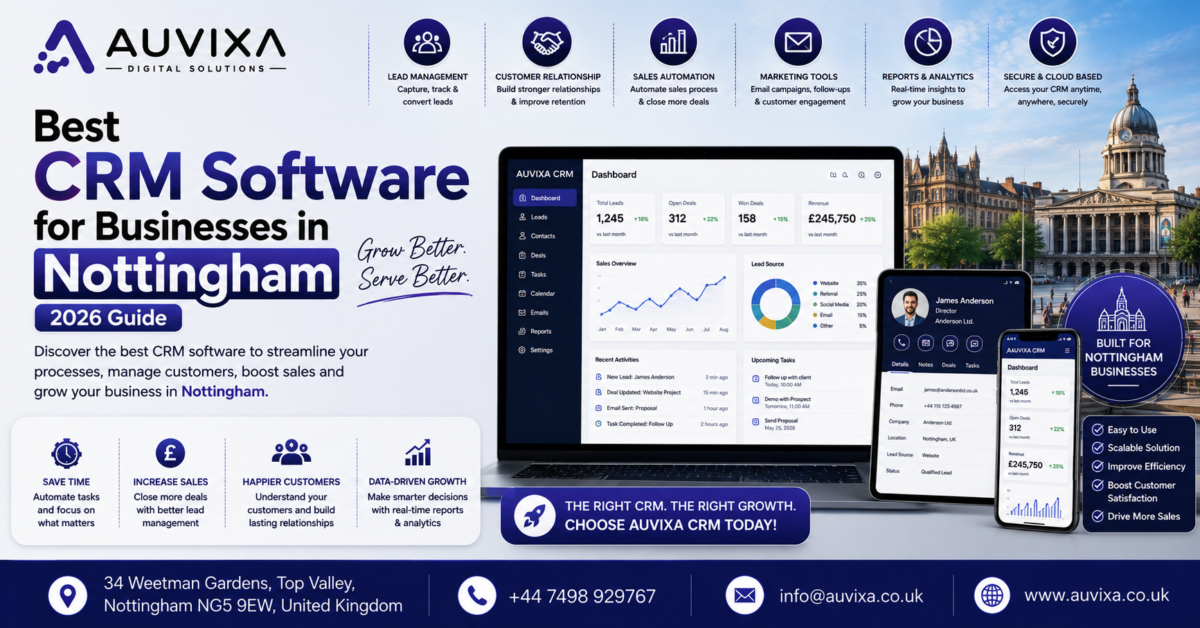
Best CRM Software for Businesses in Nottingham (2026 Guide)
In today’s highly competitive business landscape, building strong customer relationships is no longer optional—it’s a necessity. Whether you run a small startup, a growing eCommerce brand, a manufacturing company, a professional service firm, or a large enterprise in Nottingham, managing customer interactions efficiently can directly influence sales, customer retention, and long-term business growth. This is where CRM (Customer Relationship Management) software plays a crucial role. The best CRM software for businesses in Nottingham (2026 Guide) helps companies organize customer data, streamline sales processes, automate marketing, improve customer support, and make smarter business decisions using real-time insights.
As businesses across Nottingham continue embracing digital transformation, CRM software has evolved beyond simple contact management. Modern CRM platforms integrate sales, marketing, customer service, project management, analytics, invoicing, and communication into a single cloud-based system. Instead of relying on spreadsheets or disconnected databases, businesses can centralize customer information, monitor every interaction, automate repetitive tasks, and provide a personalized experience throughout the customer journey.
Cloud-based CRM solutions have become particularly popular because they offer flexibility, scalability, and remote accessibility. Employees can securely access customer information from any location using laptops, tablets, or smartphones, making collaboration easier for hybrid and remote teams. Advanced features such as Artificial Intelligence (AI), predictive analytics, automated workflows, lead scoring, and customer behavior tracking help businesses improve productivity while increasing conversion rates.
Choosing the right CRM can significantly impact operational efficiency and profitability. The ideal solution should align with your business size, industry, budget, and future growth plans. Whether you require basic contact management or a fully integrated enterprise platform, selecting the right CRM allows your team to nurture leads more effectively, strengthen customer relationships, and increase revenue.
This comprehensive 2026 Guide explores everything Nottingham businesses need to know about CRM software, including essential features, leading CRM platforms, implementation strategies, emerging trends, and practical advice for choosing the best solution for long-term success.
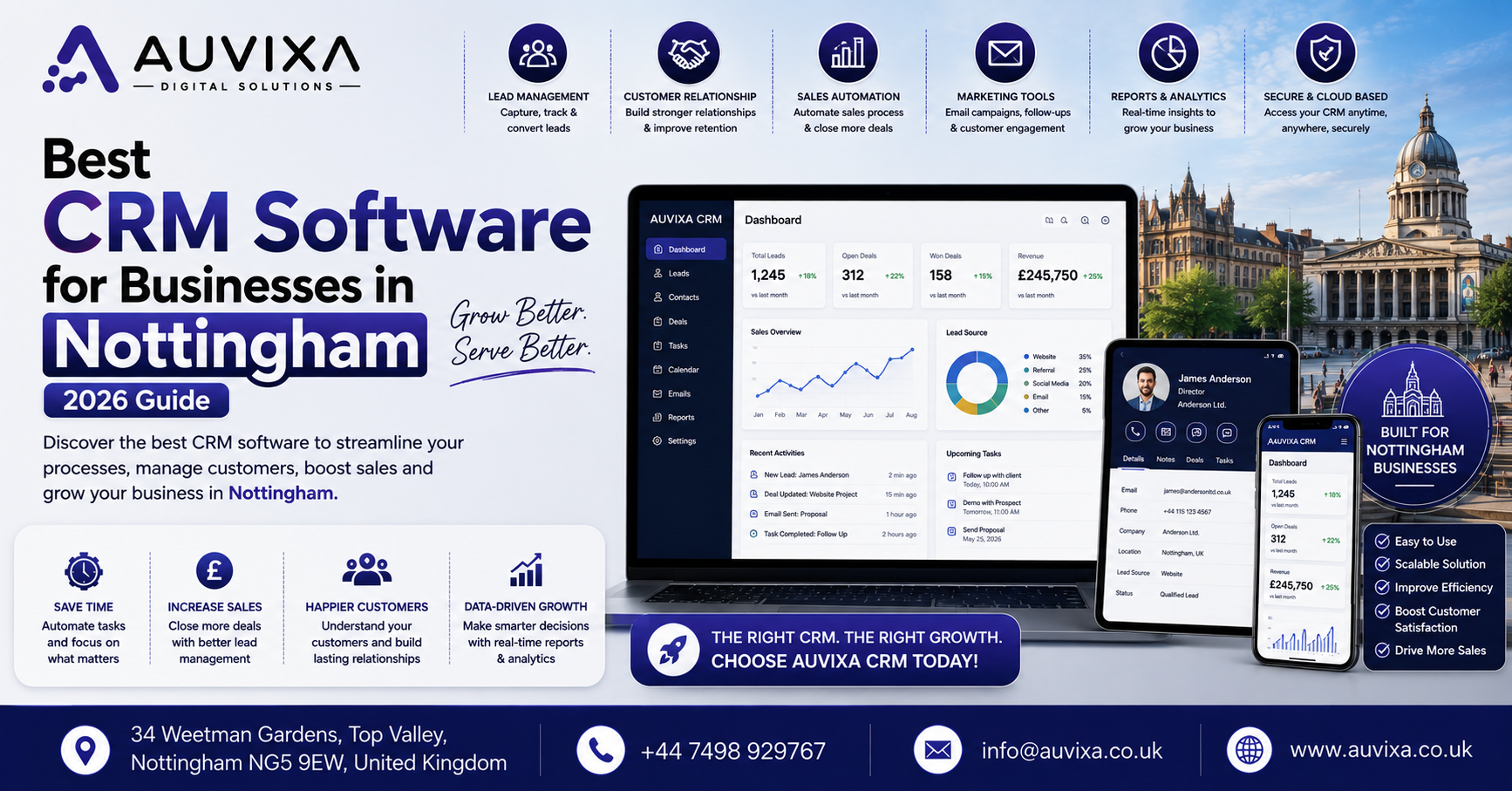
Best CRM Software for Businesses in Nottingham (2026 Guide)
What Is CRM Software?
Customer Relationship Management (CRM) software is a centralized platform that helps businesses manage interactions with prospects, customers, suppliers, and partners throughout the entire customer lifecycle. Instead of storing customer information across spreadsheets, emails, notebooks, or disconnected systems, a CRM consolidates all important data into a single, secure database that can be accessed by authorized employees anytime and from anywhere.
For businesses in Nottingham, CRM software has become one of the most valuable digital tools for improving customer service, increasing sales, and streamlining operations. Whether you operate a small local business, a growing manufacturing company, a digital agency, an estate agency, a healthcare provider, or a nationwide enterprise, CRM software enables your team to work smarter by automating repetitive tasks and providing complete visibility into every customer interaction.
Modern CRM platforms go far beyond simple contact management. Today’s systems include advanced capabilities such as sales pipeline management, email marketing automation, quotation management, customer support ticketing, AI-powered lead scoring, predictive analytics, workflow automation, project tracking, and detailed business reporting. These features allow businesses to reduce manual work while creating a more personalized customer experience.
Another major advantage is collaboration. Multiple departments—including sales, marketing, customer service, finance, and management—can access the same customer information, ensuring everyone works with accurate, up-to-date data. This eliminates duplicate records, improves communication, and enables faster decision-making.
As customer expectations continue to rise in 2026, CRM software has become a strategic investment rather than simply another business application. Organizations that successfully implement CRM solutions often experience stronger customer loyalty, improved team productivity, higher conversion rates, and sustainable business growth.
How CRM Software Works
CRM software acts as the central hub for managing every customer interaction.
A typical workflow includes:
- A potential customer submits an enquiry through your website.
- The CRM automatically creates a new lead profile.
- Sales representatives receive instant notifications.
- Customer communications are automatically recorded.
- Tasks and follow-up reminders are assigned.
- Sales opportunities move through the pipeline.
- Quotes and proposals are generated.
- Marketing campaigns are triggered automatically.
- Customer support tickets are managed from the same platform.
- Reports provide real-time performance insights.
This automation significantly reduces manual work while ensuring that no customer opportunity is overlooked.
Why Nottingham Businesses Need a CRM in 2026
Businesses throughout Nottingham are becoming increasingly competitive. Customers expect fast responses, personalized service, and consistent communication across multiple channels. Managing these expectations manually becomes difficult as businesses grow.
CRM software helps businesses by:
- Organizing customer information
- Automating repetitive administrative tasks
- Improving team collaboration
- Tracking every sales opportunity
- Enhancing customer service
- Increasing customer retention
- Improving forecasting accuracy
- Supporting remote and hybrid working
Companies that embrace CRM technology are better positioned to build stronger relationships and increase long-term profitability.
Best CRM Software for Businesses in Nottingham (2026 Guide)
Key Features to Look for in CRM Software
Choosing the right CRM requires understanding which features will deliver the greatest value for your business. While every organization has unique requirements, several core capabilities are essential for maximizing efficiency and customer satisfaction.
Contact & Lead Management
Effective CRM software stores every customer interaction in one centralized location.
Important features include:
- Contact profiles
- Lead capture
- Communication history
- Company records
- Task reminders
- Meeting scheduling
- Document storage
- Customer segmentation
Having complete customer information readily available enables sales teams to provide faster and more personalized service.
Sales Pipeline Automation
Sales pipeline management helps businesses monitor opportunities from initial enquiry to completed sale.
Features include:
- Visual sales pipelines
- Opportunity tracking
- Automated follow-ups
- Quote management
- Sales forecasting
- Revenue tracking
- Deal stage automation
- Activity reminders
These tools help sales teams close more deals while improving forecasting accuracy.
Marketing Automation
Integrated marketing automation reduces manual campaign management.
Common features include:
- Email marketing
- SMS campaigns
- Lead nurturing
- Customer segmentation
- Landing page integration
- Workflow automation
- Campaign reporting
- Lead scoring
Marketing teams can engage customers more effectively while measuring campaign performance.
Customer Support & Ticketing
Excellent customer support strengthens long-term customer relationships.
CRM support features include:
- Ticket management
- Live chat integration
- Knowledge base
- SLA tracking
- Customer history
- Automated responses
- Case management
- Satisfaction surveys
These features improve response times and enhance the overall customer experience.
Reporting & Analytics
Business decisions should be based on accurate data rather than assumptions.
CRM analytics typically provide:
- Sales reports
- Conversion rates
- Revenue forecasts
- Customer retention metrics
- Team performance dashboards
- Marketing ROI
- Customer lifetime value
- Pipeline analysis
Real-time reporting helps business leaders identify opportunities for improvement.
Third-Party Integrations
The best CRM software connects seamlessly with existing business tools.
Popular integrations include:
- Microsoft 365
- Google Workspace
- QuickBooks
- Xero
- Mailchimp
- Shopify
- WooCommerce
- Stripe
- Zoom
- Slack
- Microsoft Teams
Integrated systems eliminate duplicate data entry and improve operational efficiency.
Best CRM Software for Businesses in Nottingham
Selecting the right CRM depends on your business size, industry, operational requirements, and budget. Below are some of the leading CRM platforms for businesses in Nottingham in 2026.
1. HubSpot CRM
HubSpot CRM remains one of the most popular solutions for startups and SMEs due to its intuitive interface and generous free plan.
Best for:
- Small businesses
- Marketing agencies
- Service providers
- Startups
Key Features:
- Free CRM
- Email tracking
- Sales automation
- Marketing tools
- Customer support hub
- AI-powered reporting
2. Salesforce CRM
Salesforce is one of the world’s most comprehensive enterprise CRM platforms.
Best for:
- Large businesses
- Enterprises
- International organizations
Key Features:
- AI-powered Einstein Analytics
- Workflow automation
- Advanced customization
- Sales forecasting
- Customer service management
- Extensive app marketplace
3. Zoho CRM
Zoho CRM offers outstanding value for growing businesses.
Best for:
- SMEs
- Growing companies
- Budget-conscious organizations
Key Features:
- Lead management
- Sales automation
- Marketing campaigns
- AI assistant (Zia)
- Workflow automation
- Mobile CRM
4. Microsoft Dynamics 365
Microsoft Dynamics 365 is ideal for businesses already using Microsoft products.
Best for:
- Manufacturing
- Professional services
- Large organizations
Key Features:
- Microsoft 365 integration
- ERP connectivity
- AI insights
- Financial management
- Customer service tools
5. Pipedrive CRM
Pipedrive focuses heavily on sales pipeline management.
Best for:
- Sales teams
- SMEs
- B2B businesses
Key Features:
- Visual pipelines
- Deal tracking
- Sales forecasting
- Workflow automation
- Email integration
6. Monday Sales CRM
Monday Sales CRM combines CRM functionality with project management.
Best for:
- Agencies
- Technology companies
- Collaborative teams
Key Features:
- Custom dashboards
- Automation
- Task management
- Collaboration tools
- Reporting
-
Best CRM Software for Businesses in Nottingham (2026 Guide)
How to Choose the Right CRM for Your Business
Selecting the best CRM software for your Nottingham business is not simply about choosing the most popular platform. The right CRM should align with your company’s size, industry, sales process, budget, and long-term growth strategy. A well-chosen CRM becomes the foundation of your customer relationship strategy, helping your team work more efficiently while delivering exceptional customer experiences.
The first step is understanding your business requirements. A small startup may only require contact management and lead tracking, while a manufacturing company might need inventory integration, quotation management, and ERP connectivity. Service-based businesses often prioritize customer support features, appointment scheduling, and project management.
Scalability should also be a key consideration. As your business grows, your CRM should support additional users, increased customer data, advanced automation, and integration with new business applications. Migrating to a different CRM later can be costly and time-consuming, making scalability an important long-term investment.
Ease of use is another critical factor. Even the most feature-rich CRM will fail if employees find it difficult to use. Look for an intuitive interface, comprehensive training resources, and responsive customer support.
Security is equally important. Since CRM systems store sensitive customer and business information, ensure the provider offers data encryption, multi-factor authentication (MFA), GDPR compliance, role-based permissions, and automatic backups.
Finally, always take advantage of free trials or product demonstrations. Testing the software with your team allows you to evaluate usability, reporting capabilities, mobile access, automation tools, and integration options before making a financial commitment.
Cloud-Based vs On-Premise CRM
One of the biggest decisions businesses face is whether to choose a cloud-based CRM or an on-premise solution. While both options have advantages, cloud CRM has become the preferred choice for most organizations in 2026 due to its flexibility, affordability, and scalability.
| Feature | Cloud CRM | On-Premise CRM |
|---|---|---|
| Accessibility | Anywhere with internet | Office network only |
| Initial Cost | Lower subscription cost | Higher upfront investment |
| Updates | Automatic | Manual |
| Maintenance | Provider-managed | Internal IT team |
| Data Backup | Automatic | Business responsibility |
| Scalability | Excellent | Limited |
| Remote Working | Fully supported | Limited |
| Deployment | Quick | Longer implementation |
For most Nottingham SMEs and growing businesses, cloud-based CRM software provides greater flexibility and lower maintenance costs while supporting hybrid and remote work environments.
Common CRM Implementation Mistakes
Even the best CRM software can fail if it is not implemented correctly. Businesses should avoid these common mistakes to maximize return on investment.
1. Choosing Software Based Only on Price
The cheapest CRM may lack the features your business needs, while the most expensive platform may include unnecessary functionality. Focus on value rather than cost alone.
2. Failing to Train Employees
User adoption is essential for CRM success. Provide comprehensive training so employees understand how to use the platform effectively.
3. Ignoring Data Quality
Importing outdated or duplicate customer records reduces CRM effectiveness. Clean and organize your data before migration.
4. Overcomplicating Workflows
Avoid creating unnecessarily complex automation rules during the initial setup. Start with simple workflows and expand as your team becomes more experienced.
5. Not Defining Clear Objectives
Establish measurable goals before implementation, such as improving lead conversion, increasing customer retention, or reducing response times.
6. Neglecting Ongoing Optimization
CRM implementation is not a one-time project. Regularly review reports, gather user feedback, and optimize workflows to improve performance over time.
Future of CRM Software in 2026
CRM technology is evolving rapidly, driven by advancements in Artificial Intelligence (AI), machine learning, automation, predictive analytics, and customer data platforms (CDPs). Businesses that adopt these innovations early will be better equipped to deliver personalized customer experiences and stay ahead of the competition.
AI-powered CRM systems are becoming increasingly intelligent. They can automatically prioritize leads based on buying intent, recommend the next best action for sales teams, predict customer churn, and generate personalized email responses. These capabilities help businesses improve efficiency while increasing conversion rates.
Another major trend is hyper-personalization. CRM platforms now analyze customer behavior, purchase history, website interactions, and communication preferences to deliver highly targeted marketing campaigns and personalized recommendations. This leads to stronger customer engagement and improved loyalty.
Automation will continue to expand beyond sales and marketing. Routine administrative tasks such as scheduling meetings, updating customer records, generating reports, assigning support tickets, and sending follow-up emails will increasingly be handled automatically, allowing employees to focus on higher-value activities.
Integration is also becoming more seamless. Modern CRM platforms connect effortlessly with ERP systems, accounting software, eCommerce platforms, customer support tools, and communication applications, creating a unified business ecosystem.
As privacy regulations continue to evolve, CRM providers are investing heavily in advanced security features, GDPR compliance, encrypted data storage, and AI-driven fraud detection to protect customer information.
Businesses in Nottingham that invest in modern CRM software today will be better positioned to improve customer relationships, increase operational efficiency, and achieve sustainable growth throughout 2026 and beyond.
Best CRM Software for Businesses in Nottingham (2026 Guide)
Conclusion
Choosing the best CRM software for businesses in Nottingham in 2026 is a strategic investment that can significantly improve customer relationships, sales performance, and overall business efficiency. Whether you are a startup looking to organize leads or an established enterprise seeking advanced automation and analytics, the right CRM provides the tools needed to manage customer interactions more effectively.
Leading platforms such as HubSpot CRM, Salesforce, Zoho CRM, Microsoft Dynamics 365, Pipedrive, and Monday Sales CRM offer powerful features including contact management, sales automation, marketing campaigns, reporting, customer support, and third-party integrations. The ideal solution depends on your business size, operational requirements, budget, and future growth plans.
Cloud-based CRM systems continue to dominate the market due to their flexibility, scalability, automatic updates, and support for remote working. As AI, predictive analytics, and automation become standard features, businesses that embrace modern CRM technology will gain valuable insights, improve customer satisfaction, and create more efficient sales and service processes.
By carefully evaluating your needs, involving your team in the selection process, and investing in proper implementation and training, your Nottingham business can maximize the return on its CRM investment and build stronger, longer-lasting customer relationships.
Frequently Asked Questions (FAQs)
1. What is CRM software?
CRM (Customer Relationship Management) software helps businesses manage customer information, sales opportunities, marketing campaigns, customer support, and communication from one centralized platform.
2. Why do businesses in Nottingham need CRM software?
CRM software improves customer relationships, increases sales productivity, automates repetitive tasks, enhances customer service, and provides valuable business insights through real-time reporting.
3. Which is the best CRM software for small businesses in Nottingham?
HubSpot CRM, Zoho CRM, Pipedrive, and Monday Sales CRM are excellent choices for small and growing businesses because they offer user-friendly interfaces, scalable features, and affordable pricing.
4. Is cloud-based CRM better than on-premise CRM?
For most businesses, cloud-based CRM is the preferred option because it offers remote accessibility, automatic updates, lower upfront costs, and easier scalability.
5. What features should I look for in CRM software?
Look for contact management, lead tracking, sales pipeline automation, marketing automation, customer support tools, reporting, analytics, mobile access, security, and third-party integrations.
6. Can CRM software integrate with Microsoft 365 and Google Workspace?
Yes. Most leading CRM platforms integrate seamlessly with Microsoft 365, Google Workspace, Outlook, Gmail, Teams, and other productivity tools.
7. Is CRM software suitable for manufacturing businesses in Nottingham?
Absolutely. Many CRM platforms integrate with ERP systems, inventory management, quotation software, and production planning tools, making them ideal for manufacturing companies.
8. How much does CRM software cost in 2026?
Pricing varies depending on the provider and features. Some platforms, such as HubSpot CRM, offer free plans, while premium solutions typically range from £15 to £150+ per user per month, with enterprise plans costing more.
9. How long does it take to implement a CRM system?
Implementation can take anywhere from a few days for small businesses using standard cloud-based solutions to several months for large enterprises requiring extensive customization and data migration.
10. How can I choose the best CRM software for my business?
Assess your business goals, required features, budget, scalability, integration needs, ease of use, security standards, and customer support. Always take advantage of free trials or product demonstrations before making a final decision
